

Summer Sun Safety: Protecting Your Skin from Skin Cancer
As the summer months bring warmer weather and more time outdoors, it's important to remember that sun exposure can have lasting effects on your skin. While sunshine provides vitamin D and opportunities for outdoor activities, excessive ultraviolet (UV) radiation can damage skin cells and increase the risk of skin cancer.
Understanding the warning signs of sun damage and practicing good sun protection habits can help keep your skin healthy for years to come.
Why Sun Protection Matters
UV radiation from the sun damages the DNA within skin cells. Over time, repeated sun exposure can lead to premature aging, sunspots, wrinkles, and potentially skin cancer.
The risk accumulates throughout your lifetime, making daily sun protection important regardless of age, skin tone, or season.
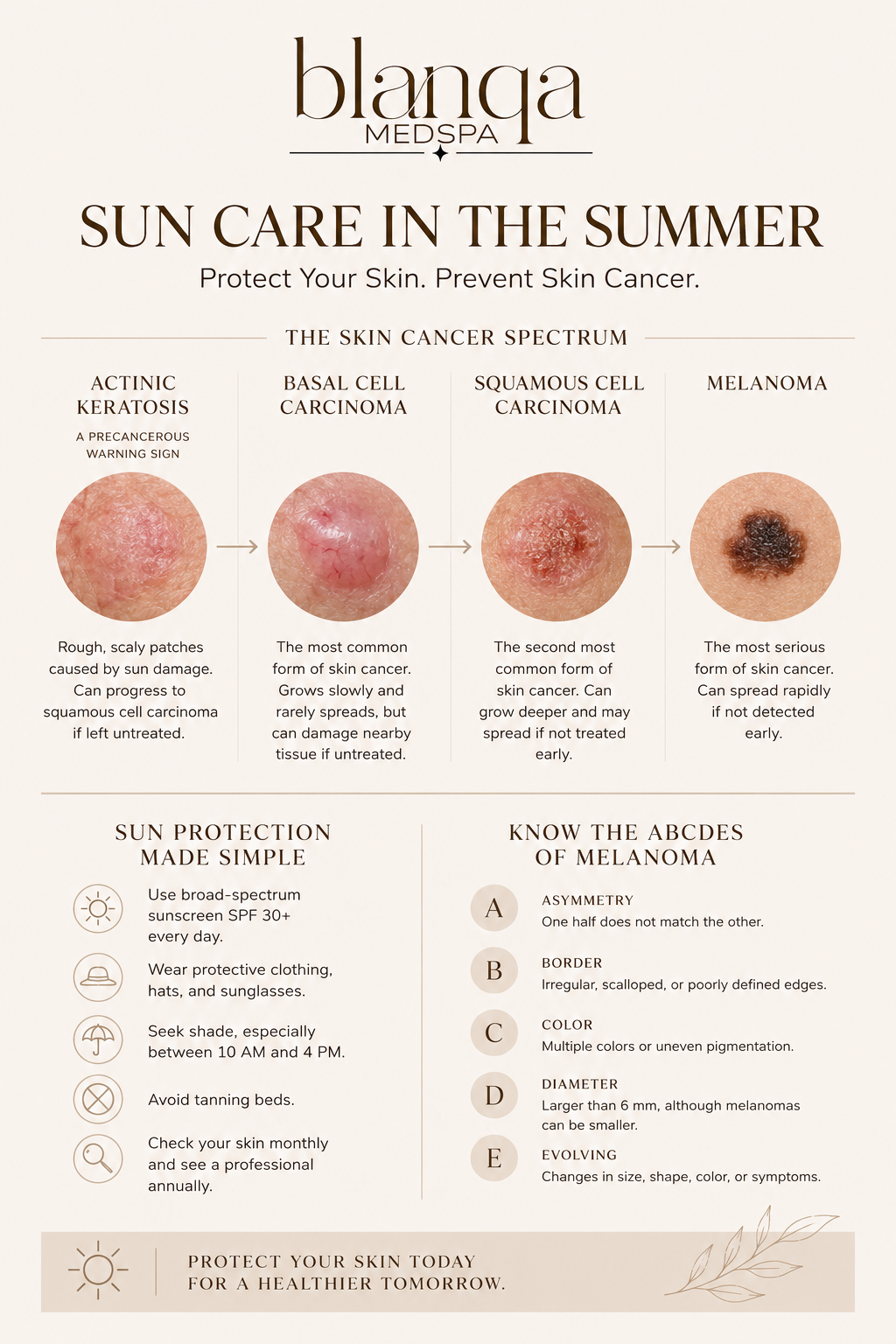
Actinic Keratosis: A Precancerous Warning Sign
Actinic keratosis (AK) is one of the most common signs of chronic sun damage.
AKs often appear as:
Rough, scaly patches
Pink, red, or flesh-colored spots
Areas that feel like sandpaper
Lesions commonly found on the face, ears, scalp, neck, forearms, and hands
While not cancerous themselves, actinic keratoses are considered precancerous lesions because they have the potential to develop into squamous cell carcinoma if left untreated.
Early evaluation and treatment are important to prevent progression.
Basal Cell Carcinoma (BCC)
Basal cell carcinoma is the most common type of skin cancer.
Characteristics may include:
A shiny or pearly bump
A persistent sore that doesn't heal
Pink growths with raised edges
Areas that bleed easily
BCC typically grows slowly and rarely spreads to other parts of the body. However, it can become locally destructive and damage surrounding tissue if not treated.
Squamous Cell Carcinoma (SCC)
Squamous cell carcinoma is the second most common type of skin cancer.
Common signs include:
Scaly red patches
Thickened or rough skin lesions
Wart-like growths
Open sores that fail to heal
Unlike basal cell carcinoma, SCC has a greater potential to invade deeper tissues and, in some cases, spread to lymph nodes or other parts of the body.
Prompt diagnosis and treatment are essential.
Melanoma: The Most Serious Skin Cancer
Melanoma develops from pigment-producing cells called melanocytes and is considered the most dangerous form of skin cancer.
Watch for the ABCDEs of melanoma:
A – Asymmetry: One half does not match the other.
B – Border: Irregular, scalloped, or poorly defined borders.
C – Color: Multiple colors or uneven pigmentation.
D – Diameter: Larger than 6 mm, although melanomas can be smaller.
E – Evolving: Changes in size, shape, color, or symptoms.
Melanoma can spread rapidly if not detected early, making regular skin checks extremely important.
How to Protect Your Skin This Summer
Use Sunscreen Daily
SPF 30 or higher
Broad-spectrum protection (UVA and UVB)
Reapply every two hours
Reapply after swimming or sweating
Wear Protective Clothing
Wide-brimmed hats
Long sleeves when possible
UV-protective sunglasses
Seek Shade
Especially between 10 AM and 4 PM when UV rays are strongest
Avoid Tanning Beds
Artificial UV exposure increases skin cancer risk
Perform Monthly Skin Self-Exams
Look for:
New lesions
Changing moles
Non-healing sores
Spots that itch, bleed, or grow
When Should You See a Healthcare Provider?
Schedule an evaluation if you notice:
A new or changing mole
Rough scaly patches that persist
A sore that won't heal
A lesion that bleeds repeatedly
Any suspicious skin growth
Early detection dramatically improves outcomes for all forms of skin cancer.
Final Thoughts
Your skin remembers every sunburn and every hour of UV exposure. Protecting your skin today can help prevent skin cancer tomorrow. Daily sunscreen use, routine skin examinations, and prompt evaluation of suspicious lesions are among the most effective ways to maintain healthy skin and reduce your risk.
This summer, enjoy the sunshine—but do so safely.
Bianca Camille Fong APRN, FNP-BC