

When Should You Start Microneedling?
"Am I too young for this?" might be the question I hear most often about microneedling — usually from patients in their late 20s or early 30s who don't have deep wrinkles yet and wonder if they're jumping the gun. It's a fair instinct, but it gets the logic backwards. Microneedling isn't a treatment you save for when damage is already visible; it works by encouraging your skin to keep producing the collagen and elastin it naturally starts making less of as you get older. Here's what the research actually says about skin aging and collagen, and how that translates into a sensible starting point — without overselling "prevention" as something it isn't.
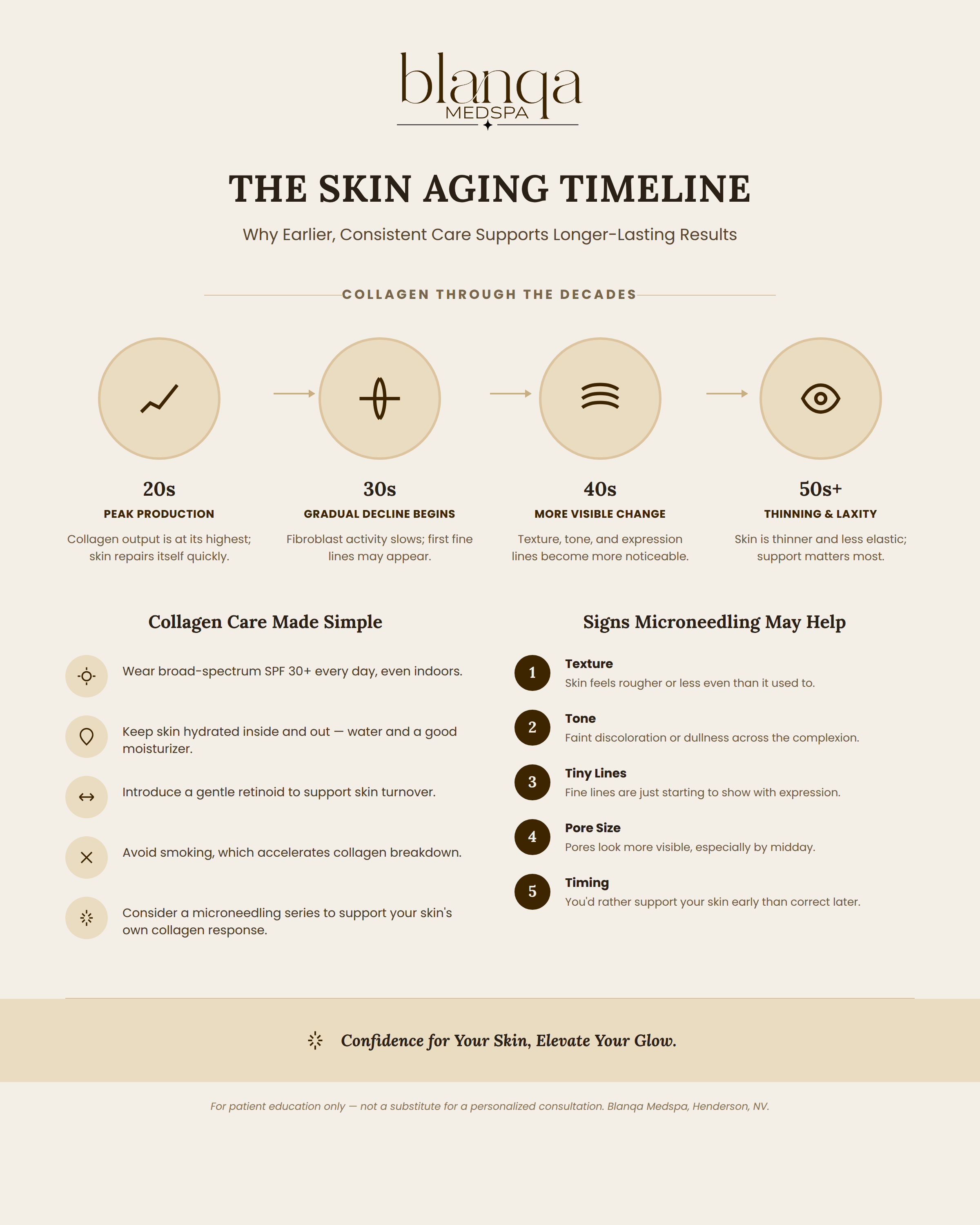
What Actually Happens to Collagen as You Age
• Collagen production is highest in young adulthood and gradually declines from there — this isn't a switch that flips at a certain birthday, it's a slow, continuous process that becomes more noticeable over decades.
• Fibroblasts (the cells that build collagen) become less efficient with age. A frequently cited study comparing skin from young adults (18–29) to skin from much older adults (80+) found procollagen production was roughly 68% lower in the older group, along with reduced ability of aging fibroblasts to attach to and interact with the surrounding collagen structure (Varani et al., American Journal of Pathology, 2006).
• Sun exposure accelerates the process considerably. In a high-UV climate like Henderson and Las Vegas, cumulative sun damage compounds chronological aging, which is part of why some people notice fine lines and texture changes earlier than they expect.
• None of this means damage is happening "suddenly" in your 30s. It means the biological trend is already moving in one direction well before it becomes visible in the mirror — which is the actual argument for starting supportive treatments before you're unhappy with what you see, not after.
Where Microneedling Fits In
Microneedling works by creating a controlled pattern of microscopic injuries in the skin, which triggers your body's own wound-healing response — including new collagen and elastin production. It doesn't reverse aging or stop time, but it does give your skin a repeated nudge toward rebuilding, which is a reasonable thing to support at any adult age rather than only once lines are already established.
What the Research Shows
• A 48-patient open-label study of a standard microneedling device, with four sessions spaced 30 days apart, found meaningful improvement in wrinkle severity, skin laxity, and skin texture by Day 150 (measured on standardized grading scales and confirmed with 3D skin-surface imaging). Seventy-three percent of patients reported visible improvement in lines, wrinkles, and texture, and 83% reported visibly smaller-looking pores. Side effects were mild, with no serious adverse events, though a handful of patients experienced cold sore flare-ups, a known risk for anyone prone to them (Ablon, Journal of Clinical and Aesthetic Dermatology, 2018).
• The fibroblast research above supports the biological rationale for starting supportive collagen-building treatments before visible damage accumulates, though I want to be direct that this specific study compared very young versus very old skin — it did not test whether starting microneedling in your late 20s produces better long-term results than starting in your 40s. That head-to-head comparison hasn't been done, so "start earlier for better results" is a reasonable inference from the biology, not a proven clinical outcome.
I think it's important to be honest about that distinction. What the evidence solidly supports is that microneedling improves visible texture, fine lines, and pore appearance in adult skin generally. What it doesn't yet prove is a specific ideal starting age — that part is reasoned from how collagen biology works, not from a trial that tracked patients for decades. If you're deciding whether it's "worth it" in your late 20s or early 30s, that reasoning is sound, but it's a judgment call, not a guarantee.
Am I a Good Candidate?
• Good candidates typically have: healthy, intact skin with no active acne or infection, realistic expectations about gradual improvement, and an interest in maintaining skin quality rather than correcting significant existing damage.
• Caution or non-candidacy includes: active acne breakouts, a history of keloid scarring, certain blood clotting disorders, pregnancy, or recent isotretinoin use.
• There's no strict minimum age, but it makes the most sense for adults who want to maintain skin quality over time rather than teenagers whose skin is still developing — this is a conversation worth having individually.
What to Expect: Timeline
• Day of treatment: Skin looks flushed for several hours to a day, similar to a mild sunburn.
• Days 2–4: Mild flaking or dryness is possible.
• A typical series: 3–4 sessions spaced about a month apart, similar to the protocol used in the research above.
• Ongoing maintenance: Periodic sessions (often a few times a year) to keep supporting collagen production over time, alongside daily sunscreen.
If you've been on the fence about whether microneedling makes sense before you have visible lines, I'd rather have an honest conversation about your specific skin and goals than tell you either "you need this now" or "wait until you're older" — neither is really the right way to think about it. Come see me for a consultation here in Henderson and we'll figure out what actually makes sense for you.
About the Author
Bianca Camille Fong, APRN, FNP-BC is a board-certified Family Nurse Practitioner and the Founder & CEO of Blanqa Medspa in Henderson, NV, as well as Fong Precision Care. She provides microneedling, wrinkle relaxer, dermal filler, and a full range of aesthetic and wellness treatments, with a focus on safe, evidence-informed care and realistic outcomes.
Blanqa Medspa
1485 W Warm Springs Rd, Suite 109B, Henderson, NV 89014
Phone: 702-997-6764 | Email: hello@blanqaLV.com
Book a consultation: https://book.prospyrmed.com/8b132bf5-7541-4ac5-a6d0-d48e94745633/select-service
“Confidence for Your Skin, Elevate Your Glow.”
Sources
• Varani, J., Dame, M.K., Rittie, L., et al. (2006). Decreased Collagen Production in Chronologically Aged Skin: Roles of Age-Dependent Alteration in Fibroblast Function and Defective Mechanical Stimulation. American Journal of Pathology, 168(6), 1861–1868.
• Ablon, G. (2018). Safety and Effectiveness of an Automated Microneedling Device in Improving the Signs of Aging Skin. Journal of Clinical and Aesthetic Dermatology, 11(8), 29–34.